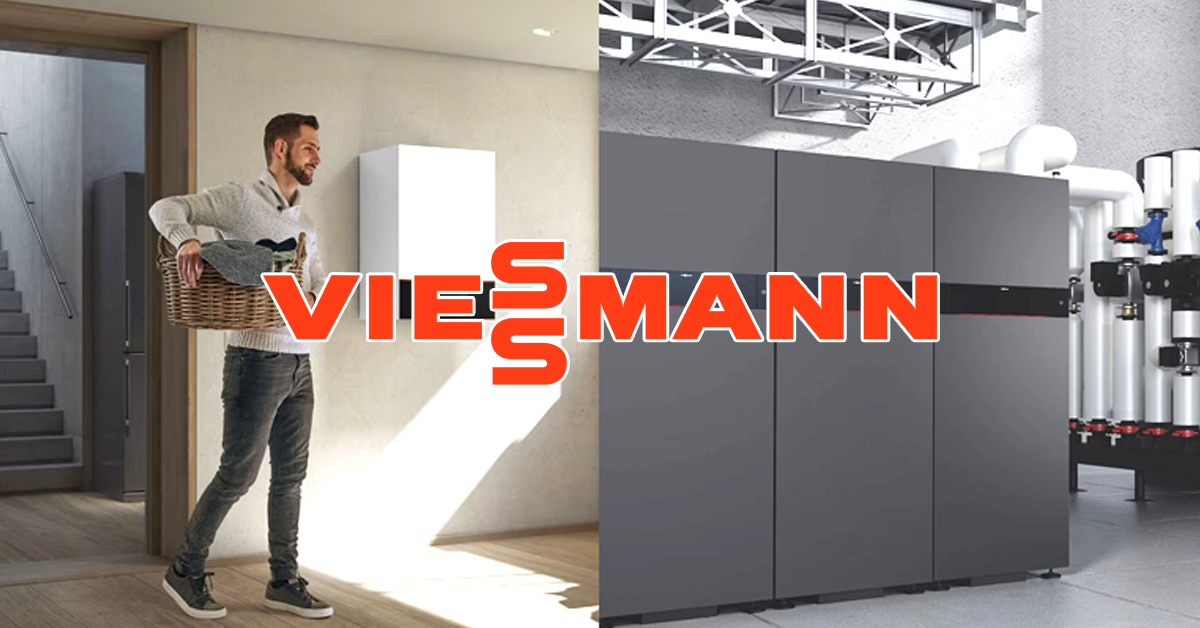
Viessmann is a German heating technology manufacturer with a commercial boiler product line that covers condensing hot water boilers, high-efficiency fire tube boilers, and large-capacity watertube boilers for commercial and institutional applications. In North America, Viessmann commercial boilers are specified in schools, hospitals, universities, multifamily residential buildings, and institutional facilities where efficiency, reliability, and long service life are primary specification criteria.
GP Energy Products represents Viessmann commercial boilers across Pennsylvania, New Jersey, Delaware, and Maryland. This article covers the commercial Viessmann product line and the applications each product is designed to serve.
The Vitodens condensing boiler line
The Vitodens line is Viessmann’s condensing hot water boiler product for commercial applications. Condensing boilers extract heat from the flue gases by cooling them below the dew point of the water vapor they contain, recovering latent heat that non-condensing boilers exhaust to atmosphere. The thermal efficiency advantage of condensing operation depends on the return water temperature of the system. Systems designed for low return water temperatures, typically below 130 degrees Fahrenheit, allow the boiler to condense consistently and deliver on the efficiency ratings published in the specification.
The Vitodens 200-W and 222-F models cover the residential and light commercial range. The Vitodens 300-W covers the commercial range with outputs from approximately 19 to 150 MBH in single unit configurations, with cascade arrangements available for larger building loads. For commercial projects where multiple Vitodens units are cascaded to serve a larger load, the Viessmann cascade controller manages staging and modulation across the full boiler plant automatically.
The Vitodens product uses Viessmann’s MatriX cylinder burner, a cylindrical radiant surface burner that modulates across a wide turndown ratio and produces low NOx emissions across the full modulation range. The stainless steel Inox-Radial heat exchanger is designed for thermal durability in condensing operation, where the combination of acidic condensate and thermal cycling creates conditions that attack heat exchangers not designed specifically for condensing service.
The Vitocrossal condensing boiler line
The Vitocrossal line covers the mid to large commercial and institutional range where the Vitodens capacity ceiling is insufficient for the building load. The Vitocrossal 200 covers outputs from approximately 318 to 2,000 MBH in single unit configurations. The Vitocrossal 300 extends the capacity range further for large institutional applications including hospitals, universities, and large commercial buildings with significant heating loads.
The Vitocrossal uses a cylindrical stainless steel heat exchanger design that provides corrosion resistance in condensing operation and thermal efficiency across the full modulation range. The modulating MatriX burner provides the same low NOx performance and wide turndown ratio as the Vitodens line scaled to the larger capacity range.
For institutional projects where the boiler plant serves a building with variable load profiles across occupied and unoccupied periods, the Vitocrossal’s modulation capability allows the boiler to respond to those load variations efficiently rather than cycling between full-fire and off. A boiler that modulates continuously at partial load produces less thermal stress on the heat exchanger and flue system than one that cycles repeatedly across the full load range.
The Vitocrossal is the Viessmann product most commonly specified in the school, university, hospital, and large commercial building applications that GP Energy serves in Pennsylvania, New Jersey, Delaware, and Maryland. For engineers specifying a boiler replacement in an institutional facility where efficiency, low emissions, and long service life are primary criteria, the Vitocrossal merits evaluation before the specification basis of design is set.
Building automation system integration
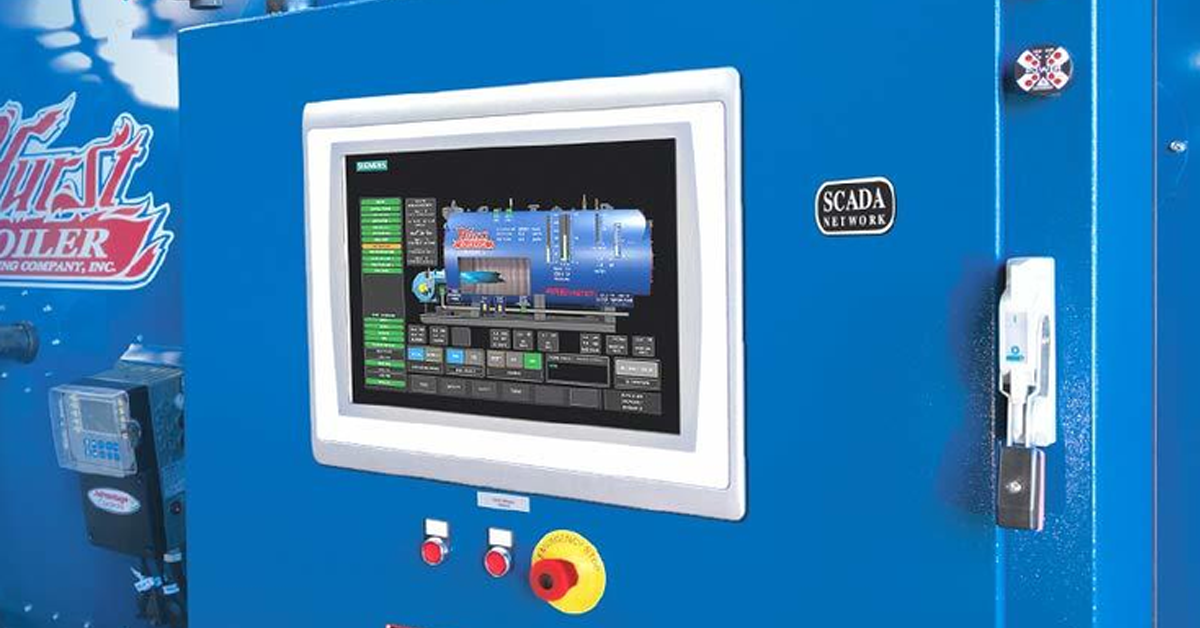
Viessmann commercial boilers communicate with building automation systems through standard protocols including BACnet and LON, and through Viessmann’s own Vitocom remote monitoring platform. BAS integration allows the building’s control system to send setpoint commands to the boiler, receive operating status and fault alerts, and incorporate boiler plant performance data into the facility’s energy management reporting.
For institutional facilities with existing BAS infrastructure, confirming the communication protocol and the point list for the Viessmann boiler before the specification is written ensures that the BAS integration is designed into the project rather than discovered as an additional scope item during commissioning. GP Energy works with the building automation contractor during the design phase to confirm the Viessmann BAS integration requirements for specific projects.
Cascade and multi-boiler applications
Multiple Viessmann boilers staged in cascade is a common configuration for commercial and institutional applications where redundancy and load matching across a wide range of building conditions are both requirements. A cascade of Vitocrossal units covers the full building load at design conditions while providing partial redundancy if one unit requires service.
The Viessmann cascade controller manages staging sequencing, lead boiler rotation, and modulation across the full cascade. For engineers designing a multi-boiler plant, the cascade controller documentation provides the sequencing logic and the BAS integration point list for the full plant rather than requiring individual boiler controllers to be integrated separately.
For multi-boiler Viessmann installations where the pump system needs to be coordinated with the boiler staging sequence, the Merion Pump Company team handles primary and secondary pump selection and can coordinate the pump staging with the Viessmann cascade controller sequence. Visit merionpump.com for more. For institutional projects where a Viessmann boiler plant is part of a larger mechanical room replacement, FabPro Systems designs modular boiler room packages that incorporate the mechanical systems surrounding the boiler plant. Visit fabprosystems.com for more. For heat exchangers serving Viessmann boiler plant applications, the HX Coils team handles custom coil and heat exchanger fabrication. Visit hxcoils.com for more.
GP Energy Products represents Viessmann commercial boilers across Pennsylvania, New Jersey, Delaware, and Maryland. If you are specifying a commercial or institutional boiler replacement and want to evaluate the Viessmann product line before the basis of design is set, reach out and we will provide the technical documentation and application support the specification needs.
References
1. Viessmann. Commercial boiler product documentation including Vitodens and Vitocrossal product lines, cascade controller specifications, and BAS integration documentation. viessmann.com
2. ASHRAE. HVAC Systems and Equipment Handbook, Chapter on Boilers. Covers condensing boiler application requirements, return water temperature design criteria, and multi-boiler staging for commercial applications. ashrae.org
3. AHRI Standard BTS-2000. Commercial Boilers performance rating standard. Covers thermal efficiency testing and certification methodology applicable to Viessmann commercial products. ahrinet.org
4. ASME CSD-1. Controls and Safety Devices for Automatically Fired Boilers. Covers safety control requirements applicable to Viessmann commercial boiler installations. asme.org