A commercial or industrial boiler is only as reliable, efficient, and safe as the control system managing it. The burner, the heat exchanger, and the pressure vessel are the hardware. The control system is what determines whether that hardware operates correctly, responds appropriately to changing conditions, protects itself and the building when something goes wrong, and provides the operating data that allows the facility team to manage the system intelligently over time.
Older boiler control systems did their job with electromechanical relays, pneumatic controllers, and analog instruments. They worked. They also produced limited operating data, required significant field calibration to maintain accuracy, and in many cases offered little visibility into system performance between annual inspections. A boiler plant running on legacy controls may be meeting its basic heating function while silently operating at reduced efficiency, accumulating fault history nobody is reviewing, and approaching failures that a modern control system would have flagged months earlier.
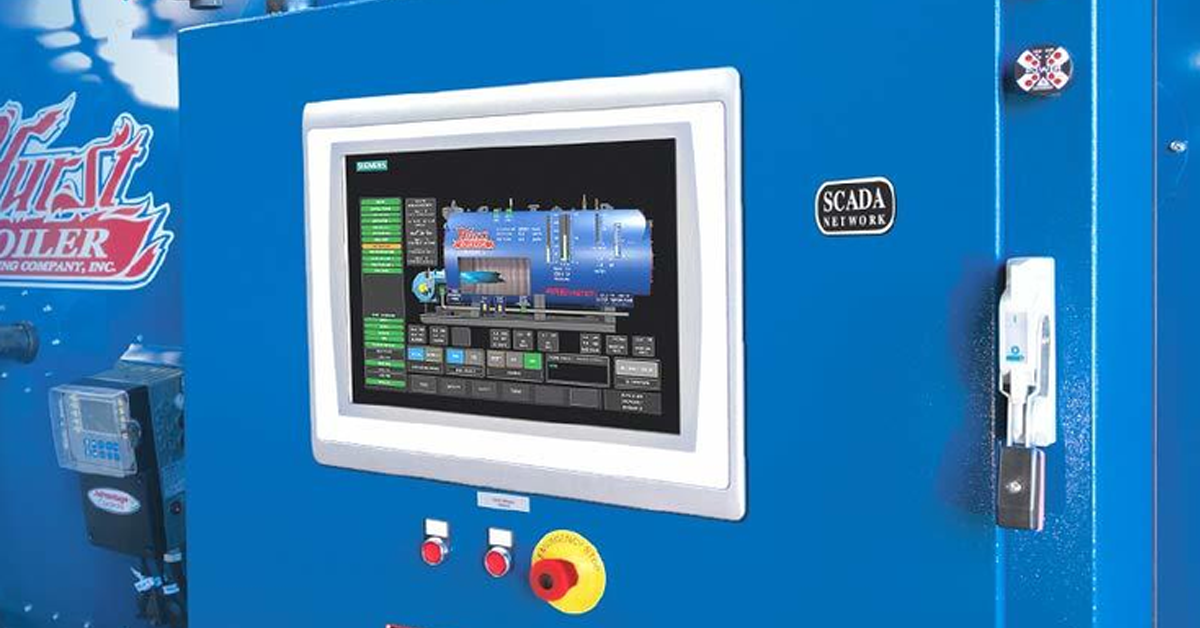
Hurst boiler control systems represent what a modern approach to boiler management looks like in a commercial and industrial application. Understanding what those systems provide is what allows engineers and facility managers to evaluate whether a controls upgrade is the right investment for an existing Hurst installation or whether modern controls should be part of a new boiler specification.
Burner management systems
The burner management system is the safety-critical core of the boiler control package. It manages the startup sequence, monitors the flame, responds to safety interlock conditions, and controls the shutdown sequence. Every commercial boiler has a burner management system in some form. What distinguishes a modern system from an older one is the precision of the monitoring, the speed of the response, and the quality of the diagnostic information it produces.
A modern Hurst burner management system monitors the flame continuously using ultraviolet or infrared flame detection, depending on the fuel and burner configuration. If the flame fails during operation, the system detects the failure, closes the fuel valve, and initiates a controlled shutdown within the response time specified by the applicable code. The failure is logged with a timestamp, a fault code, and in some systems a description of the operating conditions at the time of the failure. That information is available for review the next time a technician connects to the system, rather than existing only as the technician’s memory of the service call.
The startup sequence in a modern burner management system follows a defined, timed sequence that confirms each step before advancing to the next. Pre-purge, pilot ignition, main flame establishment, and transition to modulating control each occur within specified time windows, and a failure at any step produces a lockout with a specific fault code identifying where the sequence failed. An older relay-based burner management system may execute the same sequence but produce no useful diagnostic information when the sequence fails.
Combustion control and modulation
Combustion control manages the fuel-to-air ratio across the full modulation range of the burner. A correctly tuned combustion control system delivers the fuel-to-air ratio that produces complete combustion with minimal excess air at every firing rate from minimum to maximum. An incorrectly tuned or drifted combustion control system produces either incomplete combustion, which wastes fuel and produces carbon monoxide, or excessive excess air, which reduces efficiency by heating combustion gases that carry no additional heat transfer benefit.
Modern Hurst combustion control systems use parallel positioning or ratio control to manage the fuel and air control elements simultaneously rather than sequentially. Parallel positioning systems move the fuel valve and the combustion air damper to positions that are defined by a characterized curve for the specific burner and boiler configuration, producing consistent fuel-to-air ratios at each firing rate without the hunting and instability that sequential control systems can produce at intermediate firing rates.
For applications requiring the highest combustion efficiency and the lowest emissions, oxygen trim control adds a flue gas oxygen sensor to the combustion control loop. The oxygen trim controller adjusts the combustion air positioning to maintain a target excess oxygen level in the flue gas regardless of changes in fuel composition, ambient conditions, or burner component wear. An oxygen trim system that keeps the boiler operating at the correct excess air level continuously, rather than at the level set during the last tune-up, maintains the combustion efficiency the boiler was designed for throughout the operating season.
Sequencing and lead-lag control
For facilities with multiple boilers serving a common heating system, sequencing control determines which boilers fire, in what order, and at what firing rates in response to the building load. A well-implemented sequencing strategy fires the minimum number of boilers at efficient firing rates rather than operating multiple boilers at low firing rates where efficiency is reduced and cycling losses accumulate.
Modern Hurst sequencing control systems manage lead-lag rotation automatically, distributing operating hours evenly across the boiler plant so that no single boiler accumulates significantly more run time than the others. Even hour accumulation extends the maintenance intervals for the fleet as a whole and reduces the likelihood that the lead boiler reaches a maintenance milestone during peak heating season while the lag boilers are underutilized.
For boiler plants that include both Hurst boilers and boilers from other manufacturers, the sequencing control can be configured to manage the mixed fleet with operating priorities based on efficiency, capacity, or operating cost depending on the facility’s requirements. GP Energy Products works with facility teams on sequencing control configuration for Hurst installations across Pennsylvania, New Jersey, Delaware, and Maryland.
Building automation system integration
Modern Hurst control systems communicate with building automation systems through standard protocols including BACnet, Modbus, and LonWorks. BAS integration allows the boiler plant to receive setpoint commands from the BAS, report operating status and fault conditions to the BAS alarm management system, and participate in the facility-wide energy management strategy that the BAS coordinates.
For facilities where the BAS manages heating loads based on occupancy schedules, weather data, or demand response signals from the utility, BAS integration allows the boiler plant to respond to those signals automatically rather than requiring manual setpoint adjustments by the facility team. A boiler plant that reduces output during a utility demand response event and ramps back up at the end of the event without manual intervention delivers energy cost savings that a manually operated plant cannot match.
Operating data and fault history
The operating data that a modern Hurst control system captures and stores is one of the most underutilized assets in a commercial boiler plant. Every startup, every shutdown, every modulation step, every fault condition, and every safety interlock activation is timestamped and logged. That data is the record of how the boiler has been operating, and reviewing it regularly is the fastest way to identify developing problems before they produce failures.
A boiler that has been logging repeated low water cutoff activations without anyone investigating has been telling the facility team about a developing problem for weeks or months before the problem becomes a failure. A boiler whose combustion control has been hunting at intermediate firing rates has been operating below its designed efficiency for the same period. A boiler that has been experiencing flame failures at startup has been logging the specific fault codes that would tell a technician whether the problem is with the igniter, the gas valve, the combustion air proving switch, or the flame detector. That information is available for anyone who looks at it.
For the pump systems serving Hurst boiler plants, the Merion Pump Company team handles pump selection and pre-season service across Pennsylvania, New Jersey, Delaware, and Maryland. Visit merionpump.com for more. For applications where a Hurst boiler plant with modern controls is best delivered as a factory-assembled modular system, FabPro Systems integrates the controls into the packaged system before it ships. Visit fabprosystems.com for more.
GP Energy Products represents Hurst Boiler across Pennsylvania, New Jersey, Delaware, and Maryland. If you have an existing Hurst installation running on legacy controls or a new Hurst specification in development, reach out and we will work through the controls options for the specific application.
References
1. Hurst Boiler and Welding Company. Boiler control system documentation including burner management, combustion control, and BAS integration options. hurstboiler.com
2.NFPA 85. Boiler and Combustion Systems Hazards Code. Covers burner management system requirements for co mmercial and industrial boiler installations. nfpa.org
3. ASME CSD-1. Controls and Safety Devices for Automatically Fired Boilers. Governs safety control requirements and testing procedures for commercial boiler control systems. asme.org
4. ASHRAE. HVAC Systems and Equipment Handbook, Chapter on Boilers. Covers combustion control, sequencing, and building automation integration for commercial boiler plants. ashrae.org