
Most commercial boiler reps focus on the boiler. The equipment that makes the boiler work correctly, the deaerator that removes oxygen from the feedwater, the boiler feed system that delivers that water to the boiler at the right pressure and temperature, the condensate return unit that recovers and recycles steam condensate, receives less attention in the sales conversation and even less attention in the specification. Facilities that need this equipment often piece it together from multiple sources, coordinate between multiple manufacturers, and discover during startup that the components do not work together the way they expected.
Sellers Manufacturing covers the full industrial steam plant. Boilers, deaerators, boiler feed systems, blowdown separators, condensate return units, and medical waste autoclaves from one manufacturer, designed to work together, and available through GP Energy Products across Pennsylvania, New Jersey, Delaware, and Maryland.
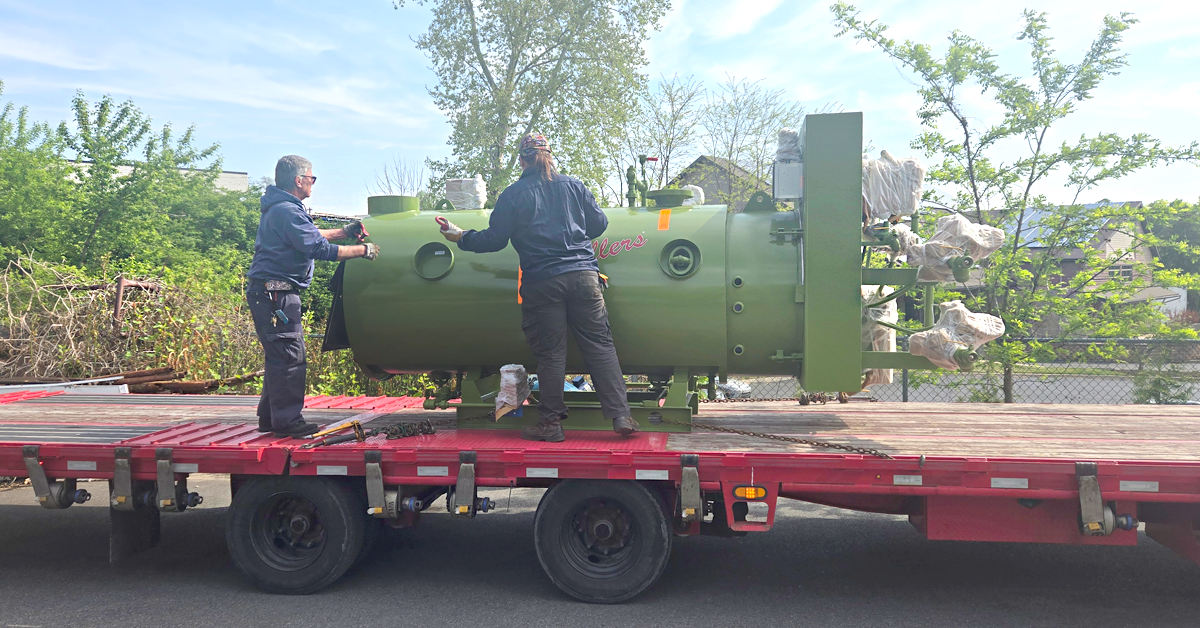
The Sellers single pass fire tube boiler
The Sellers single pass fire tube boiler is built for industrial steam applications where conventional multi-pass fire tube designs create problems. In a conventional multi-pass fire tube boiler, combustion gases make multiple passes through the tube bank before exiting through the flue. Each pass extracts heat from the gases and transfers it to the water surrounding the tubes. The design is efficient and well-suited to commercial heating and moderate-pressure industrial steam applications.
For high-pressure industrial steam applications and for applications involving difficult fuels or high-combustion-temperature processes, the multi-pass design creates thermal stress at the tube-to-tube sheet joints where the hot combustion gases first contact the cooler tube sheet. The single pass design eliminates that stress by routing combustion gases through the boiler in a single straight pass without reversals. There are no rear tube sheets exposed to peak combustion temperatures, no refractory reversal chambers, and no thermal cycling at tube sheet joints from repeated combustion gas direction changes.
The Sellers single pass fire tube covers a capacity range appropriate for industrial process steam, food processing, chemical processing, and other applications where steam quality, pressure stability, and reliability under continuous heavy-duty operation are the primary requirements. For facilities that have experienced repeated tube sheet failures or refractory problems with conventional fire tube designs, the single pass configuration addresses the root cause of those failures rather than treating the symptom.
Deaerators: what they do and why they matter
A deaerator removes dissolved gases, primarily oxygen and carbon dioxide, from boiler feedwater before it enters the boiler. Dissolved oxygen is the primary driver of corrosion in boiler pressure vessels. At the temperatures and pressures inside a commercial or industrial boiler, dissolved oxygen reacts aggressively with the steel surfaces of the drum, the tubes, and the headers. The corrosion that results is not the slow surface rusting that occurs in ambient conditions. It is accelerated pitting that penetrates tube walls and drum surfaces on a timeline measured in years rather than decades.
Carbon dioxide dissolved in feedwater converts to carbonic acid when the water is heated, contributing to corrosion and also to pH depression in the condensate return system. A condensate return system with low pH corrodes the return piping from the inside, producing iron oxide that circulates back to the boiler and deposits on heat transfer surfaces.
The deaerator removes these gases by heating the feedwater to its saturation temperature at the deaerator operating pressure, which drives dissolved gases out of solution and vents them to atmosphere. A properly functioning deaerator reduces dissolved oxygen in the feedwater to levels low enough that chemical oxygen scavengers can handle the residual without excessive chemical addition.
Sellers manufactures spray-type and tray-type deaerators across a capacity range that covers light industrial through large industrial steam plants. Spray-type deaerators atomize the incoming feedwater into a steam atmosphere, rapidly heating it to saturation temperature and releasing dissolved gases. Tray-type deaerators pass the feedwater over a series of trays in a steam atmosphere, providing longer contact time for more complete deaeration. The selection between spray and tray type depends on the capacity requirement, the feedwater temperature, and the dissolved gas concentration of the incoming water.
Boiler feed systems
A boiler feed system receives the deaerated feedwater from the deaerator storage tank and pumps it to the boiler at the pressure required to overcome the boiler operating pressure plus the static head and friction losses in the feedwater line. The boiler feed pump needs to maintain continuous feedwater delivery to the boiler under all operating conditions, from minimum firing rate through maximum load, without allowing the boiler water level to drop below the low water cutoff.
Sellers boiler feed systems integrate the deaerator storage tank, the boiler feed pump, the feedwater controls, and the makeup water supply into a packaged system designed around the specific boiler and the specific steam load it serves. The integration matters because the interaction between the deaerator operating pressure, the feedwater pump head, and the boiler drum pressure needs to be engineered as a system rather than assembled from independent components that may or may not work together correctly.
For facilities with multiple boilers, the boiler feed system needs to manage feedwater delivery to all boilers simultaneously, with controls that sequence the feedwater pumps and manage the storage tank level across the full range of combined boiler load. Sellers feed system controls are designed for multi-boiler applications and can be configured for the specific sequencing and redundancy requirements of the plant.
Condensate return and blowdown
Steam condensate carries a significant portion of the energy that went into generating the steam. Returning that condensate to the boiler feedwater system rather than discharging it to drain recovers both the energy and the treated water, reducing fuel consumption and makeup water addition. A condensate return system that is functioning correctly reduces boiler operating costs and extends the life of the water treatment program by reducing the volume of untreated makeup water entering the system.
Sellers condensate return units receive condensate from the steam distribution system, store it in a vented receiver, and pump it back to the deaerator or the boiler feed system. For applications where the condensate return pressure is insufficient to overcome the deaerator operating pressure, the condensate return pump provides the additional head required. For applications where the condensate may be contaminated by process contact, the condensate return system can be configured to divert contaminated condensate to drain rather than returning it to the boiler.
Blowdown separators recover flash steam from the boiler blowdown stream before the remaining water is discharged. The flash steam is routed back to the deaerator or to a low-pressure steam user rather than being wasted to atmosphere. For high-pressure boilers with significant blowdown requirements, blowdown heat recovery reduces energy waste and reduces the volume of hot water discharged to the drain system.
Medical waste autoclaves
Sellers manufactures medical waste autoclaves for healthcare facilities, research institutions, and other facilities that generate regulated medical waste requiring steam sterilization before disposal. A medical waste autoclave uses high-pressure steam to sterilize waste loads to the temperature and exposure time required by the applicable regulatory standard, rendering the waste non-infectious before it is disposed of as ordinary solid waste.
The autoclave application connects directly to the steam plant. A facility that generates medical waste requiring autoclave sterilization needs a steam supply that can maintain the autoclave operating pressure and temperature under load, with the consistency and reliability that a sterilization process requires. For facilities that are evaluating an autoclave installation alongside a steam plant upgrade, the Sellers product line covers both the autoclave and the steam plant equipment from a single manufacturer.
For the pump systems serving Sellers industrial steam plants, the Merion Pump Company team handles boiler feed pumps, condensate return pumps, and process fluid handling. Visit merionpump.com for more on Merion’s industrial pump capabilities. For applications where the Sellers steam plant equipment is best delivered as a factory-assembled modular system, FabPro Systems designs and fabricates packaged industrial steam systems integrating Sellers equipment with the supporting systems. Visit fabprosystems.com for more. For heat exchangers serving industrial steam applications, HX Coils handles custom coil and heat exchanger fabrication. Visit hxcoils.com for more.
References
1. Sellers Manufacturing. Product documentation covering single pass fire tube boilers, deaerators, boiler feed systems, condensate return units, and medical waste autoclaves. sellers-equipment.com
2. ASME. Boiler and Pressure Vessel Code, Section I. Governs design and fabrication requirements for power boilers and pressure vessels in the Sellers product line. asme.org
3. Heat Exchange Institute. Standards for Deaerators. Covers deaerator design, performance, and testing standards for industrial steam applications. heatexchange.org
4. ASME. Boiler and Pressure Vessel Code, Section VIII. Covers pressure vessel design requirements applicable to deaerators and condensate receivers. asme.org