
Every commercial boiler reaches a point where the repair versus replace calculation tips toward replacement. That point is not always obvious when it arrives. A boiler that has been repaired regularly and is still producing heat can look like a functioning asset right up until the repair that costs more than the remaining useful value of the equipment. Facility managers and engineers who understand the indicators that a boiler is approaching end of life make better capital planning decisions and avoid the emergency replacement scenario where the only option is whatever is available fast rather than whatever is right for the building.
This article covers the indicators that a commercial boiler is approaching end of life and the framework for making the repair versus replace decision before the equipment forces the decision on its own schedule.
Age and design life
Commercial boilers are typically designed for a service life of 20 to 30 years depending on the manufacturer, the design type, and the quality of maintenance the boiler has received over its life. A well-maintained fire tube boiler in a properly treated hydronic system may exceed its design life. A boiler that has run on poor water chemistry, received intermittent maintenance, and operated at or above its rated capacity may reach end of life well before the nominal design life.
Age alone is not a sufficient indicator of end of life. A 25-year-old boiler that has been well maintained and is operating correctly may have years of useful service remaining. A 15-year-old boiler that has been poorly maintained may be at end of life. Age is the starting point for the conversation, not the conclusion.
The more useful question is not how old the boiler is but what condition the boiler is in relative to the cost of keeping it in service. A boiler that requires a significant repair every season is communicating something about its remaining useful life that the age alone does not.
Repair frequency and cost trending
The single most reliable indicator that a boiler is approaching end of life is the trend in repair frequency and cost. A boiler whose repair costs have been increasing year over year and whose repair intervals have been shortening is telling the facility team that the underlying condition of the equipment is degrading faster than repairs can address it.
Track repair costs by boiler for at least three years if possible. A boiler that cost $2,000 to maintain in year one, $4,500 in year two, and $8,000 in year three is not a boiler with bad luck. It is a boiler with a trend that will continue. Projecting that trend forward and comparing the cumulative repair cost against the cost of a replacement boiler amortized over its expected service life is the quantitative framework for the replacement decision.
For boilers where detailed repair records are not available, the service technician’s assessment of the boiler’s condition and the likely near-term repair requirements is the next best input. An experienced technician who has serviced the boiler over multiple seasons has direct knowledge of how the equipment’s condition has changed and what is likely to fail next.
Heat transfer surface condition
The heat transfer surfaces are the core of the boiler’s function and the component whose condition most directly affects both efficiency and longevity. Tube thinning from corrosion, scale accumulation on the water side, and soot and deposit buildup on the fire side all degrade heat transfer performance and in severe cases create safety risks.
Tube wall thickness measurement using ultrasonic testing gives a direct indication of how much tube material remains. Tubes that have thinned to a fraction of their original wall thickness are at elevated risk of failure under operating pressure. A boiler inspection that identifies multiple tubes at or near minimum acceptable wall thickness is telling the facility team that tube replacements are likely in the near term, and the cost of those replacements needs to be factored into the repair versus replace calculation.
For fire tube boilers, a tube replacement that involves a significant fraction of the tube bundle is a major repair whose cost may approach or exceed the cost difference between repair and replacement when the remaining life of the refractory, the pressure vessel, and the controls are also considered.
Refractory condition
For dryback fire tube boilers, the refractory lining at the rear of the boiler requires periodic replacement as it degrades from thermal cycling over time. A refractory that is cracked, spalled, or missing sections is a heat loss and efficiency problem that gets worse over time. The cost of refractory replacement on an aging dryback boiler needs to be evaluated against the alternative of replacing the boiler with a wetback design that eliminates the refractory maintenance requirement entirely.
For facility managers who have been managing refractory repairs on an aging dryback boiler, the refractory replacement conversation is the natural opportunity to evaluate whether the next refractory replacement is the last maintenance investment that makes sense on that boiler or whether a wetback replacement is the better capital decision.
Controls and combustion system condition
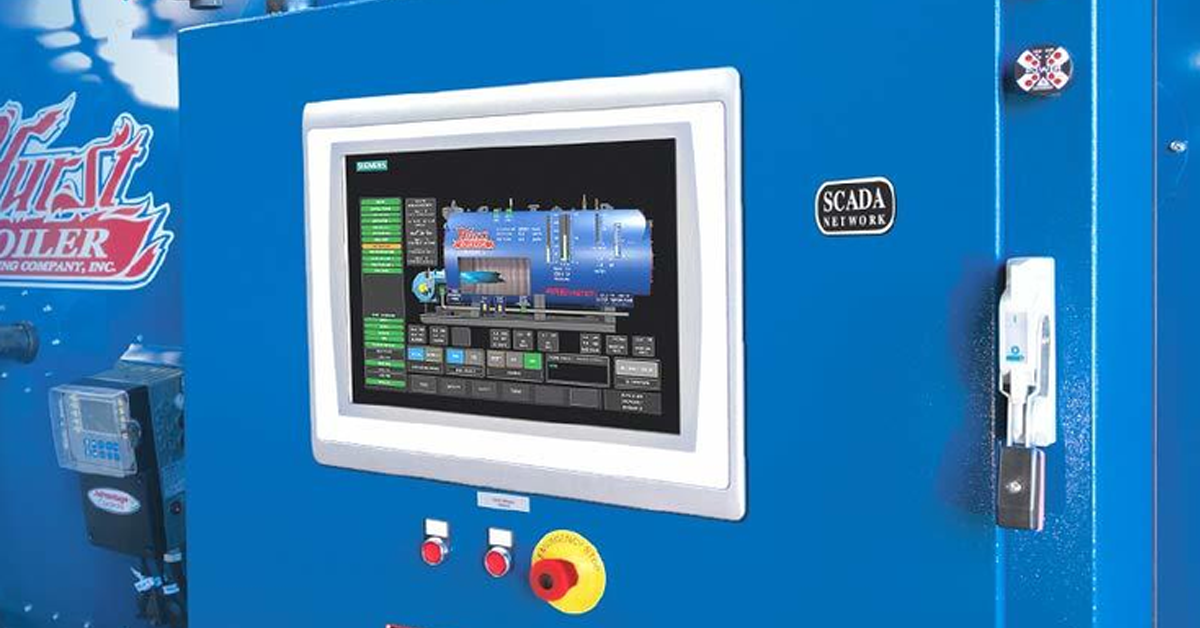
Aging boiler controls and combustion systems accumulate calibration drift, component wear, and in some cases obsolescence that affects both safety and efficiency. A boiler running on pneumatic or relay-based controls from the 1990s may be functioning in the sense that it produces heat, but it is not functioning in the sense that a modern control system would define functioning. It is producing heat without the combustion efficiency, the safety monitoring capability, or the operating data that a modern system provides.
Controls obsolescence by itself is not necessarily a reason to replace a boiler. Modern controls can often be retrofitted to an existing boiler at a fraction of the cost of a new boiler. But when controls obsolescence is combined with aging heat transfer surfaces, frequent repairs, and refractory issues, the controls retrofit cost needs to be added to the overall repair cost picture rather than evaluated in isolation.
The replacement decision framework
The replacement decision comes down to a comparison of two numbers: the cost of keeping the existing boiler in service for a defined period, and the cost of replacing it with new equipment over the same period.
The cost of keeping the existing boiler in service includes the projected repair costs based on the trend analysis, the efficiency penalty of operating aging equipment relative to what a new boiler would achieve, and the risk premium associated with operating equipment that is more likely to fail unexpectedly.
The cost of replacement includes the capital cost of the new boiler and installation, offset by the efficiency savings relative to the existing equipment and the elimination of the repair cost trend.
For most aging commercial boilers, the replacement decision becomes compelling when the projected repair costs over the next three to five years approach or exceed 50 percent of the replacement cost, when the boiler has experienced or is at risk of a major failure that would take it offline during heating season, or when a significant efficiency improvement is available from a replacement that changes the economic comparison materially.
For engineers and facility managers in Pennsylvania, New Jersey, Delaware, and Maryland who are evaluating a boiler replacement, the GP Energy Products team works through the repair versus replace analysis and the replacement specification for Hurst, Sellers, Unilux, and Viessmann equipment. For the pump systems serving the replacement boiler plant, the Merion Pump Company team handles pump selection and can coordinate the pump specification with the boiler replacement. Visit merionpump.com for more. For facility managers considering a full boiler room replacement as a factory-assembled packaged system, FabPro Systems handles the modular boiler room design. Visit fabprosystems.com for more.
References
1. American Boiler Manufacturers Association. Boiler Room Guide. Covers boiler end of life assessment, repair versus replace decision framework, and replacement planning for commercial boilers. abma.memberclicks.net
2. ASHRAE. HVAC Systems and Equipment Handbook, Chapter on Boilers. Covers commercial boiler service life, maintenance requirements, and replacement decision criteria. ashrae.org
3. ASME. Boiler and Pressure Vessel Code, Section I. Covers inspection requirements and acceptance criteria for commercial boiler pressure vessels and heat transfer surfaces. asme.org
4. Association for Facilities Engineering. Facility Maintenance and Operations Guide. Covers capital asset replacement decision frameworks for mechanical equipment including commercial boilers. afe.org