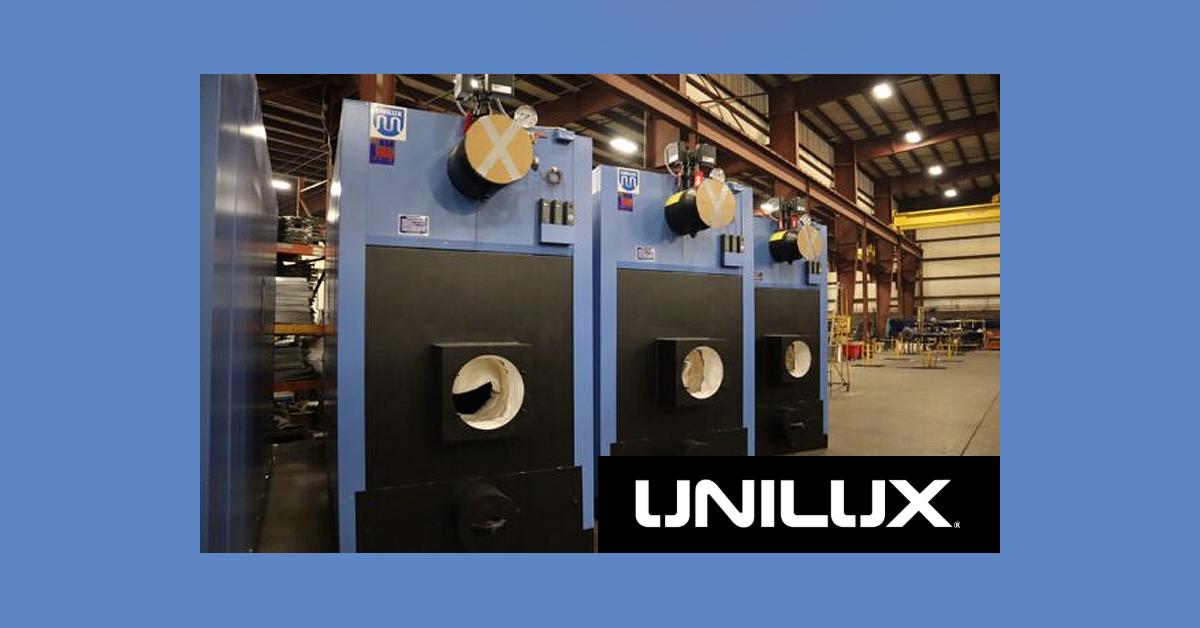
Unilux Advanced Manufacturing has been building bent-tube watertube boilers in Schenectady, New York since 1979. The design is distinctive, the product line covers a wide capacity range, and the boiler shows up on commercial and industrial jobs in ways that can catch a mechanical contractor off guard if they have not worked with it before. This article covers what mechanical contractors need to know about Unilux boilers before they show up on a job site.
The bent-tube watertube design
Most commercial boilers a mechanical contractor encounters are fire tube boilers. In a fire tube design, hot combustion gases pass through tubes surrounded by water. In a watertube design, water passes through tubes surrounded by hot combustion gases. The Unilux bent-tube design is a watertube boiler where the tubes are bent rather than straight, which produces a five-pass combustion gas path through the tube bundle.
The five-pass design means the combustion gases travel back and forth through the tube bundle five times before exiting through the flue connection. Each pass extracts additional heat from the combustion gases before they leave the boiler. The result is 85 percent thermal efficiency as a standard rating, not an optimized or condensing efficiency figure, across the full product line.
The bent-tube geometry also creates what Unilux calls tangent tube construction, where adjacent tubes touch along their length. This configuration produces convective internal pumping as the heated water rises through the tubes, which contribuves to efficient water circulation without relying entirely on an external pump to maintain flow through the boiler.
For mechanical contractors, the practical implication of the watertube design is that the Unilux looks and installs differently from a fire tube boiler. The tube bundle is accessible from the top of the boiler rather than through a rear door. The flue connection is at the top rather than the rear. The burner is at the front on a forced-draft configuration. Understanding the access points and the connection locations before the boiler arrives on the job site prevents the kind of surprises that add time to a startup.
The product line
Unilux manufactures hot water, low-pressure steam, and high-pressure steam boilers across a capacity range from approximately 1,200 MBH to 65,000 MBH. The product families relevant to commercial and industrial jobs in the GP Energy territory are the W Series hot water boilers, the LS Series low-pressure steam boilers, the HS Series high-pressure steam boilers, and the XP Series which is Unilux’s express production program for jobs with tight delivery requirements.
The W Series and LS Series cover the commercial range from hospitals, universities, and large commercial buildings through light industrial process applications. The HS Series serves industrial process applications requiring steam pressures above the low-pressure range. The standard design pressure across the Unilux line is 160 PSI under ASME Section IV, with higher pressures available for applications that require them.
The XP Series is worth knowing specifically because it addresses the delivery timeline problem that comes up on replacement jobs. When a boiler fails in service and needs to be replaced quickly, lead times on standard commercial boilers can be measured in weeks. The XP Series prioritizes production efficiency to deliver hot water boilers faster than standard lead times, which makes it a meaningful option when a contractor is managing an emergency replacement and cannot wait for a standard production schedule.
What contractors need to know about installation
The Unilux bent-tube design is available in factory-assembled configurations for units that can be transported to the site as a complete assembly, and in field-erect configurations for larger units that require on-site assembly. Field-erect units do not require on-site welding under ASME Section I and IV, which simplifies the inspection and certification requirements for the installation.
For factory-assembled units, the boiler arrives with the tube bundle, the outer casing, the burner, and the trim assembled and tested at the factory. The mechanical contractor’s scope at the site is the gas connection, the water supply and return connections, the flue connection, the electrical connection to the control panel, and the condensate connection if applicable. The factory assembly means the contractor is making connections rather than assembling the boiler, which compresses the installation timeline compared to a field-assembled alternative.
The top-access tube bundle means that vertical clearance above the boiler is a more critical installation consideration for Unilux than for most fire tube boilers where rear access is the primary service requirement. Confirm the installed ceiling height against the service access requirement in the Unilux installation manual before the boiler is set in its final location.
Replacement tubes
One of the less commonly known capabilities Unilux offers through GP Energy is replacement tubes. Unilux manufactures replacement boiler tubes for all industrial boiler types and brands, not just Unilux equipment, using American-made steel with expedited turnaround times. For contractors managing a boiler retubing project on any brand of boiler, the replacement tube capability through Unilux and GP Energy is worth a conversation before sourcing tubes elsewhere. The expedited production capability is particularly relevant for jobs where a boiler is out of service and the facility needs it back online quickly.
For pump systems serving Unilux boiler installations, the Merion Pump Company team handles primary and secondary pump selection and can coordinate the pump specification with the Unilux installation requirements. Visit merionpump.com for more. For packaged mechanical room installations where a Unilux boiler is part of a larger factory-assembled system, FabPro Systems handles the modular boiler room design. Visit fabprosystems.com for more.
References
1. Unilux Advanced Manufacturing. Product documentation including W Series, LS Series, HS Series, and XP Series specifications, installation requirements, and replacement tube capabilities. uniluxam.com
2. ASME. Boiler and Pressure Vessel Code, Section I and Section IV. Covers field-erect and factory-assembled boiler construction and inspection requirements applicable to Unilux installations. asme.org
3. ASME CSD-1. Controls and Safety Devices for Automatically Fired Boilers. Covers safety control and burner management requirements applicable to Unilux commercial boiler installations. asme.org
4. American Boiler Manufacturers Association. Boiler Room Guide. Covers installation, commissioning, and startup requirements for commercial watertube boiler installations. abma.memberclicks.net