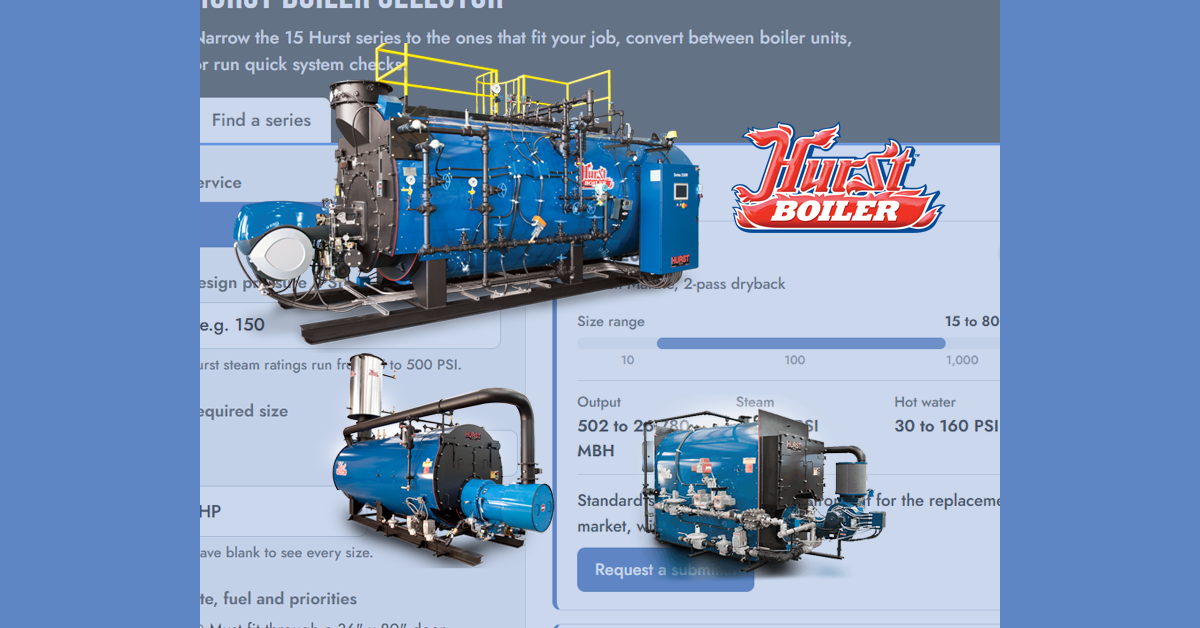
Hurst Boiler and Welding Company manufactures a product line that covers steam and hot water applications from 6 horsepower to 4,500 horsepower, with fire tube, water tube, and electric boiler configurations serving commercial, institutional, and industrial applications. GP Energy Products represents Hurst across Pennsylvania, New Jersey, Delaware, and Maryland. For engineers specifying a commercial or industrial boiler, understanding where each Hurst product fits in the application matrix is the starting point for a defensible basis of design.
This article covers the Hurst product line from an engineering selection perspective, organized by application type and capacity range.
Fire tube boilers: the Series 200 and Series 500
The Hurst Series 200 is a dryback scotch marine fire tube boiler available in steam and hot water configurations from 15 to 800 horsepower. The dryback design uses a refractory-lined rear combustion chamber that requires periodic inspection and replacement as it degrades from thermal cycling over time. The Series 200 is a well-established design suited to applications where first cost is the primary selection criterion and where the maintenance program includes regular refractory inspection.
The Hurst Series 500 is a wetback scotch marine fire tube boiler that eliminates the refractory rear combustion chamber by using a water-backed combustion chamber instead. The wetback design reduces maintenance requirements relative to the dryback Series 200, improves thermal efficiency by eliminating heat loss through the refractory, and extends the interval between major maintenance events. The Series 500 is available from 15 to 800 horsepower in steam and hot water configurations and is the product GP Energy recommends when long-term maintenance cost and operational reliability are weighted in the selection.
For engineers comparing the Series 200 and Series 500, the selection criteria that typically favor the wetback Series 500 are applications where maintenance access is difficult or infrequent, where the boiler will operate at high firing rates for extended periods, and where the owner values reduced maintenance over a lower first cost. The criteria that favor the dryback Series 200 are primarily first cost sensitivity and applications where the maintenance program is robust enough to support regular refractory inspection and replacement.
The Series 100 and small commercial range
The Hurst Series 100 covers the small commercial range from 6 to 15 horsepower in steam and hot water configurations. This product serves applications where the heating load is modest, where space is constrained, and where a simple, reliable boiler is the primary requirement. Schools, small commercial buildings, and supplemental heating applications are typical Series 100 applications.
For engineers specifying in the small commercial range, the Series 100 provides Hurst’s manufacturing quality and parts availability at the lower end of the capacity range where the product selection options are more limited than in the mid-range.
The Series 700 and Series 800 for high-pressure applications
The Hurst Series 700 is a two-pass water tube steam boiler designed for high-pressure steam applications above the pressure range that fire tube boilers typically serve. Industrial process applications, autoclave sterilization systems, and facilities requiring steam at pressures above standard commercial HVAC boiler ratings are the primary markets for the Series 700.
The Hurst Series 800 extends the water tube product line to larger capacities and higher pressures for heavy industrial applications. For engineers specifying in industrial process markets in Pennsylvania, New Jersey, Delaware, and Maryland, the Series 700 and Series 800 cover the application range where fire tube design is not appropriate and where the boiler specification needs to account for the higher pressure requirements, the different piping and safety valve requirements, and the different operational considerations that come with high-pressure steam service.
Hurst boiler controls and burner management
Hurst boilers are available with a range of controls configurations from basic operating controls through full burner management systems with programmable logic controllers, flame safeguard systems, and building automation system integration. For engineers specifying commercial and institutional boiler applications, the controls selection affects the BAS integration scope, the operator interface requirements, and the safety documentation required for the installation.
The Hurst EDGE control system provides a touchscreen operator interface with data logging, remote monitoring capability, and BAS integration through Modbus and BACnet. For institutional owners who want visibility into boiler plant performance through their existing BAS infrastructure, the EDGE control system provides the integration capability without requiring a third-party controls overlay.
For engineers specifying a multi-boiler plant, the Hurst master boiler control sequences multiple boilers for lead rotation, load matching, and efficiency optimization. The sequencing logic and the BAS integration point list for the full plant are documented in the Hurst controls submittal, which GP Energy provides during the design phase rather than at the time of equipment submittal.
Cascade and multi-boiler plant design
Multiple Hurst boilers staged in cascade is the standard configuration for commercial and institutional applications above the single boiler capacity range, and for applications where N plus 1 redundancy is required. A cascade of Series 500 wetback fire tube boilers covers the full building load at design conditions while providing partial redundancy if one boiler requires service during the heating season.
For engineers designing a multi-boiler plant, the questions that affect the Hurst product selection are the total plant capacity, the minimum and maximum turndown required from the plant, the redundancy requirement, and the physical footprint available in the mechanical room. A two-boiler plant with each boiler sized for 75 percent of the peak load provides meaningful redundancy during shoulder season conditions when the failed boiler’s capacity is not needed. A three-boiler plant with each boiler sized for 50 percent covers the peak load with any single boiler out of service.
For the pump systems serving a Hurst boiler plant, the Merion Pump Company team handles primary and secondary pump selection and can coordinate the pump staging logic with the Hurst master boiler control sequence. Visit merionpump.com for more. For institutional and industrial projects where the Hurst boiler plant is part of a larger packaged mechanical room, FabPro Systems handles the modular boiler room design and fabrication. Visit fabprosystems.com for more. For heat exchangers serving Hurst boiler plant applications, the HX Coils team handles custom coil and heat exchanger fabrication. Visit hxcoils.com for more.
GP Energy Products represents Hurst Boiler across Pennsylvania, New Jersey, Delaware, and Maryland. For engineers evaluating Hurst for a commercial or industrial application, reach out before the basis of design is set and we will provide the technical documentation and application support the specification requires.
References
1. Hurst Boiler and Welding Company. Product documentation including Series 100, 200, 500, 700, and 800 specifications, EDGE controls documentation, and master boiler control sequencing. hurstboiler.com
2. ASHRAE. HVAC Systems and Equipment Handbook, Chapter on Boilers. Covers fire tube and water tube boiler selection criteria, multi-boiler plant design, and controls integration for commercial applications. ashrae.org
3. ASME. Boiler and Pressure Vessel Code, Section I. Covers design and construction requirements for power boilers including the Hurst Series 700 and 800 high-pressure products. asme.org
4. ASME CSD-1. Controls and Safety Devices for Automatically Fired Boilers. Covers controls and burner management system requirements applicable to Hurst boiler installations. asme.org