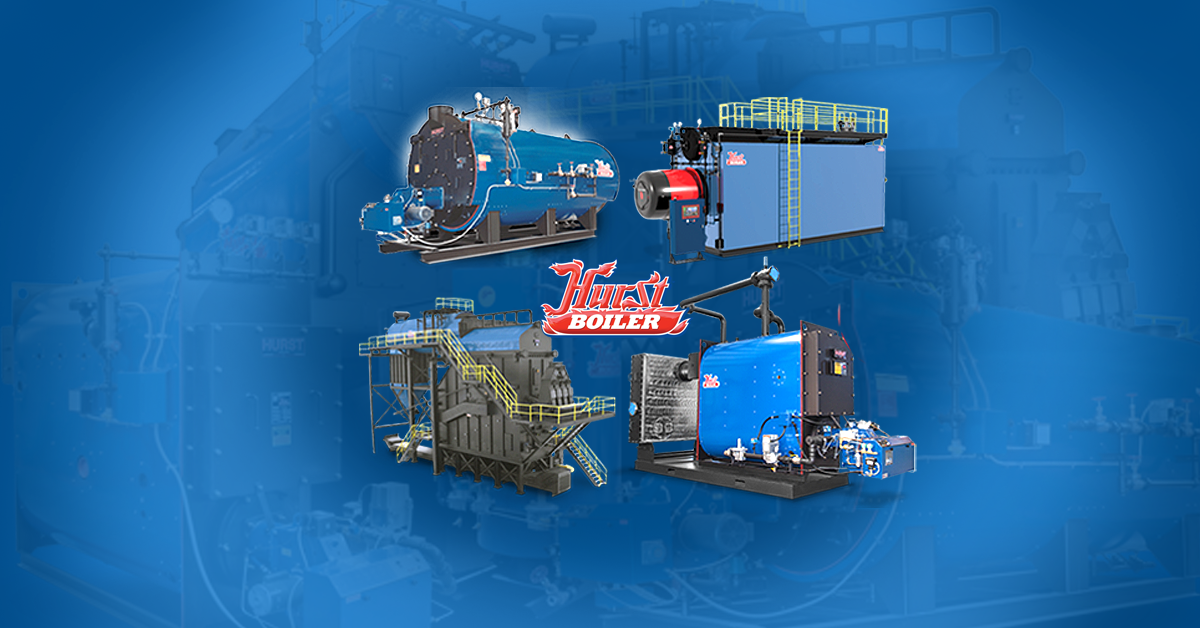
Hurst Boiler and Welding Company has been manufacturing commercial and industrial boilers since 1967. The product line has expanded considerably since then, covering fire tube, watertube, biomass, solid fuel, and hybrid configurations across a capacity range that spans from small commercial applications through the largest industrial steam plants. For engineers and facility managers evaluating a boiler replacement or new installation, understanding where each Hurst product fits in the application range is the starting point for a productive specification conversation.
GP Energy Products represents Hurst across Pennsylvania, New Jersey, Delaware, and Maryland. This article covers the full Hurst product family and the applications each product is designed to serve.
Fire tube boilers: the commercial and industrial workhorses
The Hurst fire tube line covers the broadest range of commercial and industrial applications and represents the largest portion of the Hurst product portfolio. Fire tube boilers pass combustion gases through tubes surrounded by water, transferring heat from the gases to the water or steam in the vessel. The Hurst fire tube line spans from 6 HP to 800 HP depending on the specific series and covers both steam and hot water configurations.
The Series 500 four-pass wetback Scotch Marine boiler is the flagship of the Hurst fire tube line and the product we covered in detail in our Week 16 article. The wetback design eliminates the refractory rear door that degrades in competitive dryback designs, the four-pass combustion gas routing extracts more heat per unit of fuel than two or three-pass equivalents, and the front door design allows single-technician tube access without removing the burner or disconnecting controls. The Series 500 covers 30 to 1,500 BHP at pressures up to 300 PSI for steam and hot water applications.
The Series 200 two-pass wetback Scotch Marine covers smaller commercial applications from 6 to 100 BHP. It brings the wetback design advantage to the light commercial range where smaller footprint and lower first cost are primary considerations alongside the maintenance advantages of the wetback configuration. The Series 200 is the right answer for smaller commercial buildings, restaurants, laundries, and light industrial applications where the Series 500 capacity range exceeds the load requirement.
The Series 400 three-pass dryback Scotch Marine covers applications where a dryback configuration is specified or where the application conditions make the dryback design appropriate. The Series 400 runs from 15 to 800 BHP and covers a wide range of commercial and industrial steam and hot water applications. For applications where refractory maintenance is acceptable and where the three-pass design meets the efficiency requirement, the Series 400 is a competitive option within the Hurst portfolio.
Watertube boilers: high capacity and high pressure
The Hurst watertube product line covers the upper end of the capacity range and the higher-pressure applications that exceed what fire tube boilers can practically achieve. In a watertube boiler, water circulates through tubes and combustion gases pass over the outside of the tubes, which allows the pressure vessel to be designed for much higher operating pressures than the fire tube configuration.
The Hurst Industrial Watertube covers capacities from 10,000 to 200,000 pounds of steam per hour at pressures up to 900 PSI. These are large industrial boilers serving power generation, large process steam applications, and industrial plants with steam demands that exceed what any fire tube boiler can produce. The watertube configuration at this scale handles the combination of capacity and pressure that large industrial applications require.
For facility managers and engineers working on large industrial steam plants, the Hurst watertube line is worth evaluating alongside competitive watertube products. The territory for large industrial watertube applications in Pennsylvania, New Jersey, Delaware, and Maryland is covered by the GP Energy team and by Unilux for the high-temperature hot water applications that the Unilux 5-pass watertube design addresses particularly well. Visit gpenergyproducts.com for more on the Unilux product line.
Biomass and solid fuel boilers: fuel flexibility at industrial scale
Hurst has been manufacturing biomass and solid fuel boilers since the early years of the company and the biomass product line is one of the most developed in the commercial boiler market. For facilities where wood waste, agricultural residue, or other biomass fuels are available at low cost, a Hurst biomass boiler can deliver significant fuel cost savings relative to natural gas or oil-fired equipment.
The Hurst biomass line covers a range of fuel types including wood chips, wood pellets, bark, bagasse, rice hulls, and other agricultural and industrial byproducts. The combustion system design varies by fuel type, with different stoker and grate configurations appropriate for different fuel characteristics. Hurst engineers work with the facility to specify the combustion system for the specific fuel that will be available at the site rather than offering a generic biomass boiler that may not perform well with the actual fuel.
For facilities considering a fuel switching project from natural gas or oil to biomass, the economics depend on the delivered cost of the biomass fuel, the capital cost of the boiler and fuel handling system, and the operating costs including ash handling and combustion system maintenance. The GP Energy team can support that analysis for projects in Pennsylvania, New Jersey, Delaware, and Maryland.
Hybrid fuel systems
Hurst hybrid fuel boilers are designed for facilities that want the flexibility to operate on multiple fuel types depending on availability and cost. A hybrid system that can burn natural gas, oil, and biomass or solid fuel gives the facility the ability to optimize fuel selection based on current market conditions without committing permanently to a single fuel source.
Hybrid fuel systems are more complex than single-fuel boilers and require more sophisticated combustion controls, fuel handling infrastructure, and operational procedures. They are appropriate for large facilities with the operational capacity to manage that complexity and with fuel cost exposure large enough to justify the premium for the flexibility.
Ancillary equipment: the full boiler room from one manufacturer
One of the practical advantages of the Hurst product line is the availability of ancillary equipment that integrates with the boiler. Hurst manufactures deaerators, boiler feed systems, blowdown separators, condensate return units, and chemical feed systems that are designed to work together with the Hurst boiler as a complete boiler room package.
For facility managers who want to minimize the number of vendors involved in a boiler room replacement, the Hurst ancillary equipment line allows the primary mechanical systems in the mechanical room to come from a single manufacturer. For engineers who want a coordinated equipment submittal package, the Hurst line provides that without requiring the engineer to coordinate between separate equipment manufacturers.
For applications where a full boiler room package including Hurst equipment and supporting systems is best delivered as a factory-assembled modular system, FabPro Systems designs and fabricates modular boiler room packages that integrate Hurst boilers with pump systems, heat exchangers, and controls into a single factory-tested assembly. Visit fabprosystems.com for more on the FabPro packaged boiler room approach. For the pump systems serving Hurst installations, the Merion Pump Company team handles boiler feed pumps, condensate return pumps, and distribution system pumps. Visit merionpump.com for more.
References
1. Hurst Boiler and Welding Company. Full product line documentation including Series 200, Series 400, Series 500, watertube, and biomass product families. hurstboiler.com
2. ASME. Boiler and Pressure Vessel Code, Section I. Governs design and fabrication standards for power boilers across the Hurst product range. asme.org
3. NFPA 85. Boiler and Combustion Systems Hazards Code. Covers safety requirements for commercial and industrial boiler installations across all fuel types. nfpa.org
4. American Boiler Manufacturers Association. Boiler Room Guide. Covers boiler selection, ancillary equipment, and boiler room design for commercial and industrial applications. abma.memberclicks.net