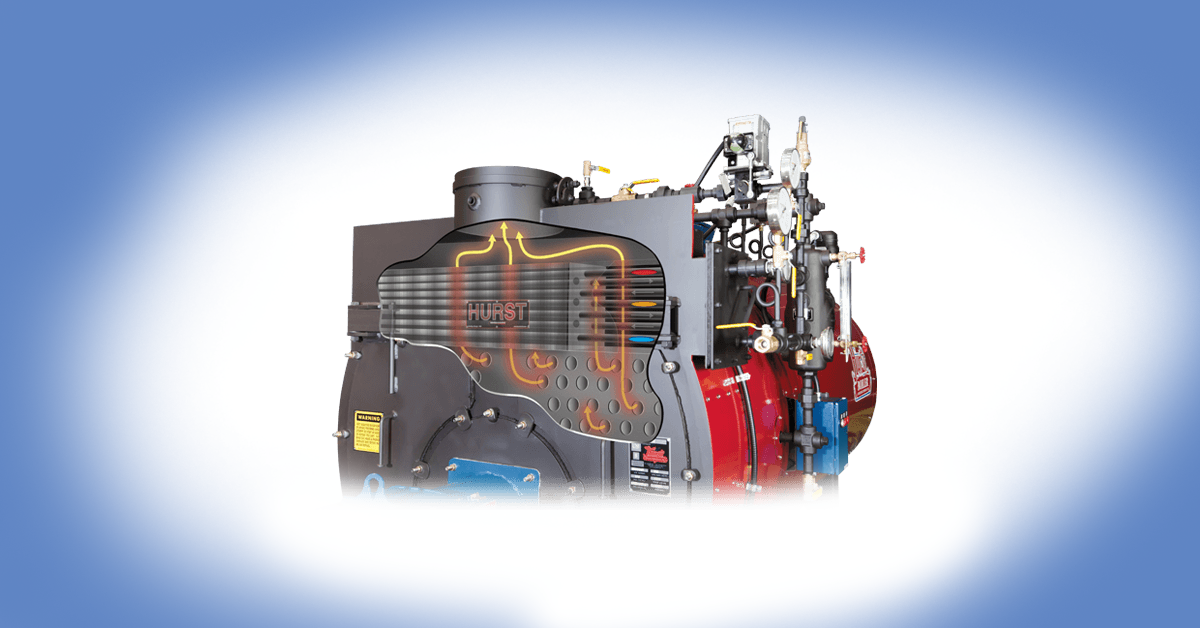
A steam boiler burns fuel to make steam, and some of that heat leaves through the stack. Two upgrades go after that loss from different directions: an economizer recovers heat from the flue gas, and oxygen trim keeps the burner from sending more air through the boiler than it needs. Either can pay off on its own, and they work well together.
What an economizer does
A feedwater economizer transfers heat from the flue gas to the water going into the boiler. Water that arrives warmer takes less fuel to turn to steam. The U.S. Department of Energy estimates that an economizer can reduce steam boiler fuel use by 5 to 10 percent and often pays for itself in under two years. That estimate applies best to larger boilers, generally above 100 boiler horsepower, running at higher pressures with a significant load year-round.
A common rule of thumb is that boiler efficiency rises about 1 percent for every 40°F drop in stack temperature. If the stack gas is leaving 100°F to 150°F hotter than the steam, there is heat to recover.
The limit on how far you can cool the stack
There is a floor. Cool the flue gas too far and water vapor condenses in the stack, which causes corrosion. The DOE sheet gives lowest safe stack temperatures by fuel, starting at 250°F for natural gas. Condensing designs are built for that condition, but a standard economizer and standard stack are not. The right equipment depends on the fuel, the load, and the existing stack.
What O2 trim does
A burner needs some extra air beyond the theoretical amount to burn the fuel completely. Too little leaves unburned fuel. Too much carries heat out of the stack. The right amount is found by measuring oxygen in the flue gas.
An oxygen trim system measures that oxygen continuously and feeds the result back to the burner controls, which adjust the air. DOE notes that an online oxygen analyzer is worth considering where fuel composition or steam flow varies widely. The same sheet gives the rule of thumb that efficiency rises about 1 percent for each 15 percent reduction in excess air.
They work together
An economizer recovers heat after combustion, and trim improves the combustion itself. Both depend on a clean boiler. Fouled heat transfer surfaces raise stack temperature and limit what either upgrade can do, so a good tune-up and clean surfaces come first.
How to decide
Start with measurements. Record the stack temperature, the flue gas oxygen, the load profile, and the fuel use. Those numbers show where the loss is and how much of it is worth chasing. A boiler that runs lightly or seasonally may see a smaller benefit than one that runs year-round.
For plate heat exchangers in data center cooling, Merion Pump Company covers that in today’s article. Visit merionpump.com for more. For preheat coils on outdoor air, HX Coils covers that in today’s article. Visit hxcoils.com for more. For starting a skid project during the winter slowdown, FabPro Systems covers that in today’s article. Visit fabprosystems.com for more.
References
1. U.S. Department of Energy, Advanced Manufacturing Office. Steam Tip Sheet #3: Use Feedwater Economizers for Waste Heat Recovery. energy.gov
2. U.S. Department of Energy, Advanced Manufacturing Office. Steam Tip Sheet #4: Improve Your Boiler’s Combustion Efficiency (DOE/GO-102012-3405, January 2012). nrel.gov