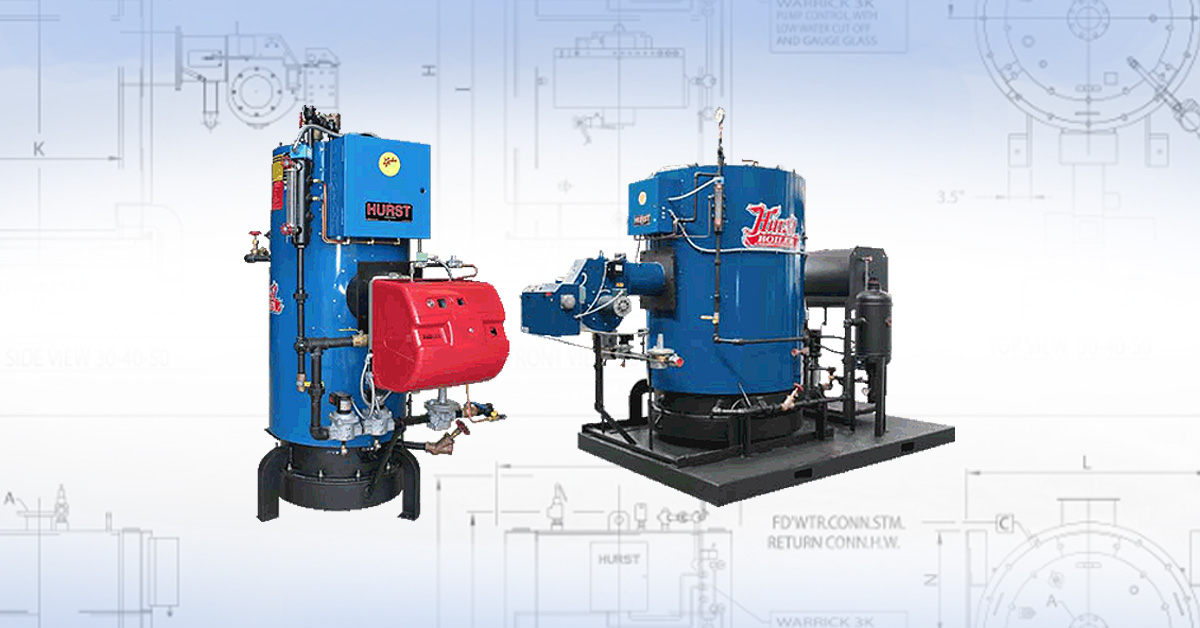
When we announced Hurst Boiler as a new line a few weeks ago, we mentioned the vertical firetube as the product worth knowing about. This post is the follow-through on that. The vertical firetube deserves its own conversation because the application it serves is specific, the need is real, and most boiler manufacturers simply do not offer a competitive solution for it.
Most boiler manufacturers do not build a vertical firetube in a meaningful size range. Hurst does. For engineers specifying steam systems in pharmaceutical manufacturing, food processing, and industrial facilities where mechanical room space is the defining constraint, that is not a minor distinction. It is often the difference between a system that fits the building and one that requires structural modifications the project budget cannot support.
Why space is a non-negotiable constraint in pharma applications
Pharmaceutical manufacturing facilities are built around process, not around mechanical rooms. Clean rooms, manufacturing suites, laboratory spaces, and controlled environments take priority. The mechanical infrastructure that supports those spaces gets whatever footprint is left, which is often smaller than a standard horizontal scotch marine boiler requires.
That constraint is not unique to new construction. Retrofits and upgrades in existing pharma facilities run into it constantly. A horizontal boiler that needs to be replaced cannot always be replaced with an equivalent horizontal unit when the space has been modified over the years. A vertical configuration that occupies more than fifty percent less floor space than a comparable horizontal boiler changes what is possible in those situations.
The decisions they make in that environment are consequential. A deferred repair that an experienced operator would have caught becomes an emergency call at two in the morning. An efficiency problem that someone with context would have recognized as a symptom gets treated as the problem itself. Equipment that should have been replaced gets run past its reliable service life because nobody in the building has enough history with it to make the call.
“Most boiler manufacturers do not build a vertical firetube. Hurst does. For pharmaceutical facilities with space constraints and clean steam requirements, that distinction matters more than most spec sheets will tell you.”
The Hurst VIX Series: what the product actually delivers
The Hurst VIX Series is the vertical firetube configuration in the Hurst lineup. It uses a two-pass fire tube design with X-ID finned fire tubes for heat transfer efficiency, and it is available as a skid-mounted packaged system that installs without requiring a special foundation. The footprint is more than fifty percent smaller than most standard vertical boilers in the same capacity range.
Hurst VIX Series – Key Specifications
| Design Two-pass fire tube with X-ID finned fire tubes |
Construction 100% water-backed, industrial grade |
| Capacity range 30 to 125 BHP steam, 30 to 160 BHP hot water |
Installation Skid-mounted packaged system, no special foundation required |
| Steam pressure Up to 350 PSI steam |
Access Eye-level control panel, all valves and controls within reach |
| Footprint More than 50% smaller than standard vertical boilers |
CAD/BIM 2D and 3D CAD and Revit files available at hurstboiler.com |
Where the application case is strongest
The vertical firetube fits best in three scenarios that engineers working in the Mid-Atlantic region encounter regularly. The first is a pharmaceutical or biotech facility where clean steam is required for sterilization, humidification, or process heating and the mechanical room cannot accommodate a horizontal configuration. The second is a food processing operation where the same space constraint applies and steam quality requirements are defined by the process. The third is any industrial or commercial retrofit where the replacement boiler needs to fit a footprint the original equipment never had to work around.
In all three cases, the VIX delivers what the application requires without asking the building to accommodate the equipment. That is the right way to approach a constrained-site boiler specification, and it is why the vertical firetube belongs on the short list for these applications even when the horizontal configuration is the more familiar choice.
GP Energy Products represents Hurst Boiler across Eastern Pennsylvania, Southern New Jersey, and Delaware. If you have a constrained-site application or a pharma boiler specification in development, reach out before the spec is written.
Specifying a boiler for a pharma or constrained-site application?
GP Energy Products is an authorized Hurst Boiler rep serving Eastern PA, Southern NJ, and Delaware. We can support the application review, provide CAD and Revit files, and be part of the pre-spec conversation before the design is locked.
References
1. Hurst Boiler and Welding Co., Inc. VIX Series Packaged Vertical Firetube Boiler. Product specifications, capacity range, footprint data, and application guidance for the VIX Series vertical firetube configuration. hurstboiler.com/boilers/vertical-boilers/vix_series
2. Hurst Boiler and Welding Co., Inc. CAD and Revit Download Solution. BIM-compatible 2D and 3D CAD and Revit objects for Hurst boiler models including the VIX Series. hurstboiler.com/literature
3. ASME. Boiler and Pressure Vessel Code (BPVC), Section I: Rules for Construction of Power Boilers. Governs design and fabrication standards for power boilers including vertical firetube configurations. asme.org
4. ISPE. ISPE Good Practice Guide: Steam Systems. Covers clean steam requirements, steam quality standards, and boiler selection considerations for pharmaceutical manufacturing applications. ispe.org
Note: All references should be verified and linked before publication. If a source cannot be confirmed, the associated claim should be softened or removed.