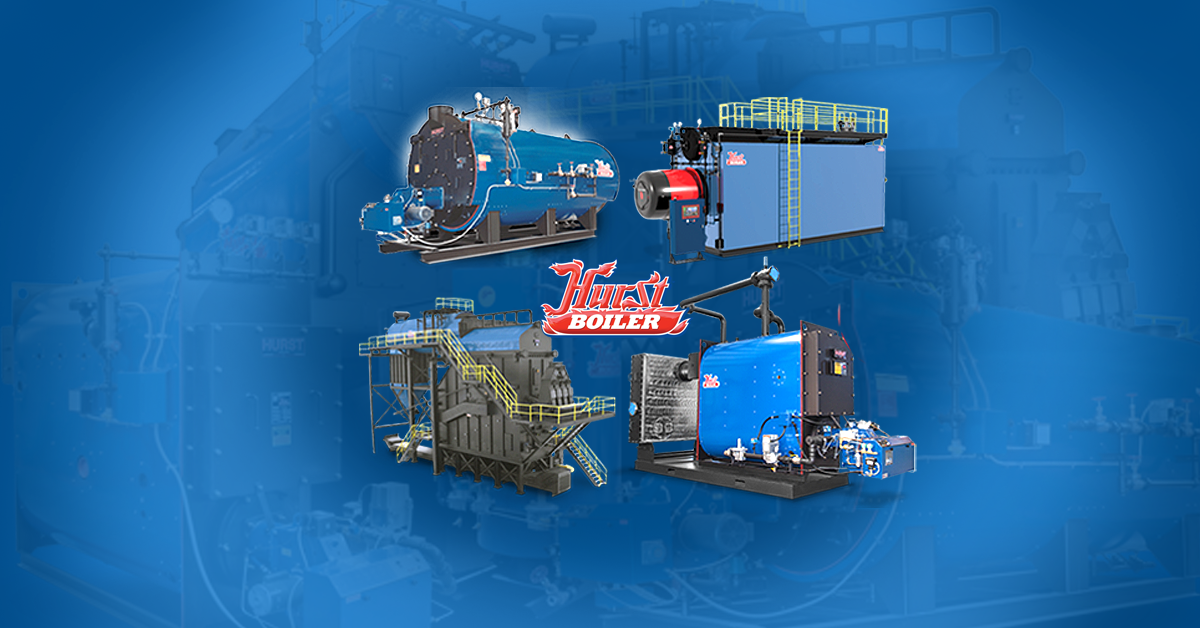
Scotch marine, vertical fire tube, firebox, water tube, biomass. Five configurations, five different jobs. Here is how engineers and contractors should think about which one fits their application
Why configuration matters
Specifying a boiler is not just a matter of sizing. Two projects with identical BTU requirements can call for completely different configurations depending on available space, fuel source, operating pressure, application type, and long-term maintenance expectations.
Hurst Boiler manufactures across all five major configurations, which is part of why we rep them. There is rarely a project we cannot match to the right Hurst product. But that range of options also means the selection conversation matters. The wrong configuration on the right project creates operational headaches that outlast the warranty.
Here is how we think about matching each configuration to the jobs it does best.
01 — Scotch Marine (Fire Tube): The workhorse
Key specs: 15 to 800 HP, pressures to 300 PSIG, available in 2-pass, 3-pass, and 4-pass versions, dryback and wetback options, steam or hot water, fires gas, oil, or combination, minimum 81% efficiency, UL listed packaged burner, factory tested.
Best for: Commercial and industrial facilities that need a reliable, proven fire tube design for standard steam or hot water applications. Hospitals, schools, office buildings, and manufacturing facilities all live in this category. The wetback design extends useful life cycles and reduces maintenance. The dryback is preferred where tube access is a priority. If you are specifying a boiler for a conventional mechanical room application with a broad range of capacity requirements, the Scotch Marine is almost always the conversation starter.
02 — Vertical Fire Tube: Space-constrained installations
Key specs: Available in tubeless cyclone design and VIX Series with X-ID finned fire tubes. Compact vertical footprint. Skid mounted packaged systems. ASME CSD-1 approved. Factory assembled and fully automatic. The cyclone design eliminates tubes entirely, removing the risk of tube loosening or burnout.
Best for: Projects where floor space is the primary constraint. Retrofit applications in existing mechanical rooms with limited square footage. Facilities where horizontal boiler access is impractical. The tubeless cyclone is particularly well suited for environments where maintenance access is limited, since there are no tubes to inspect, roll, or replace. The VIX Series with finned tubes offers a smaller footprint than most standard vertical units while still delivering high efficiency.
03 — Firebox: Fuel flexibility first
Key specs: Three-pass firebox design. Thickest boiler steel in the industry. ASME code constructed and stamped. Available for gas, oil, heavy oil, and combination gas/oil. Low NOx configurations available. Includes unified refractory base floor, steel skids, and lifting eyes. 15 PSI steam or 30 PSI hot water.
Best for: Applications where fuel type is variable or where heavy oil firing is a requirement. Industrial facilities that need fuel flexibility built into the spec, including backup fuel capability. The three-pass design and thicker steel construction make the Firebox a strong candidate for demanding duty cycles. Also a practical choice where Low NOx compliance is a specification requirement, since the configuration supports it directly and the burner selection is straightforward.
04 — Water Tube: High pressure, high output
Key specs: Capacities from 20 to 2,500 BHP, 670 to 83,688 MBTU/HR, up to 86,250 PPH steam output. Hybrid designs incorporate a water-tubed boiler-type water membrane with a two-pass fire tube scotch marine vessel. Pressures from 100 to 900 PSI on hybrid models.
Best for: Industrial process applications requiring high pressure steam output beyond what fire tube configurations can deliver. Large-scale manufacturing, chemical processing, food production, and facilities with significant and variable steam demand. The larger steam disengagement area in hybrid water tube designs provides higher quality steam, greater storage capacity for rapid response to demand spikes, and more thermal storage. When a consulting engineer is specifying above 300 PSIG or above 800 BHP, the water tube or hybrid water tube conversation starts here.
05 — Biomass: Renewable fuel, carbon reduction
Key specs: Solid fuel fired and biomass systems from 3,450 to 60,000 lbs/hr steam output. Pressures from 100 to 900 PSI. Compatible fuels include wood, bark, agricultural biomass, rice husk, poultry manure, dairy slurry, sugar cane bagasse, MSW, construction debris, sawdust, shavings, and sludge. Moisture content range 8 to 50 percent. Hurst provides complete system design from fuel storage through exhaust gas emission mitigation.
Best for: Facilities with access to waste fuel streams and a mandate or financial incentive to reduce fossil fuel dependency. Food processing, agricultural operations, lumber and wood product manufacturers, and campuses or institutions with sustainability commitments. The economics work best where the fuel is either free or a byproduct of operations. Carbon credit eligibility is a financial consideration worth quantifying early in the specification conversation.
How to think about the selection
When we are working through a specification, we typically move through these questions in order:
What is the required output and at what pressure? Below 300 PSIG and 800 BHP, a fire tube design covers most applications. Above that, the water tube conversation starts.
What fuel is available and is flexibility required? If heavy oil or alternative fuels are in the picture, the Firebox earns a closer look. If biomass is viable, it changes the economic calculation entirely.
What are the space constraints? A tight mechanical room almost always points toward the vertical fire tube family. The through-the-door LPW Series modified Scotch design exists specifically for retrofit situations with doorway clearance issues.
What is the maintenance environment? Tubeless cyclone designs reduce long-term maintenance burden significantly. In facilities with limited in-house technical staff, that matters.
Are there emissions requirements? Low NOx configurations are available across the line but need to be called out early. They affect burner selection and they affect cost.
How GP Energy approaches this conversation
We are not a catalog. We carry Hurst because their range covers virtually every commercial and industrial application we encounter in the Delaware Valley market, and because they stand behind the equipment when something goes wrong on the job.
Our role in the specification process is to help engineers and contractors narrow the field early, before the spec is locked, so the right configuration ends up in the drawing set rather than an expensive substitution later.
If you have a project in the pipeline and you are not sure which direction to take the boiler specification, reach out before you close the design. That conversation is free. A change order is not.
GP Energy Products — info@gpenergyproducts.com — gpenergyproducts.com
Serving eastern PA, southern NJ, and Delaware.
References
1. Hurst Boiler. Scotch Marine Fire Tube Boilers. Two-pass, three-pass, and four-pass configurations, dryback and wetback options, pressure ratings, efficiency specifications, and UL listed packaged burner details. hurstboiler.com/boilers/scotch_marine
2. Hurst Boiler. Vertical Boilers. Tubeless cyclone and VIX Series vertical fire tube configurations including X-ID finned fire tube design, compact footprint specifications, and ASME CSD-1 approval details. hurstboiler.com/boilers/vertical-boilers/vix_series
3. Hurst Boiler. Firebox Boilers. Three-pass firebox design specifications including steel construction, fuel flexibility options, Low NOx configurations, and ASME code construction details. hurstboiler.com/boilers/firebox
4. Hurst Boiler. Watertube and Hybrid Boilers. High pressure boiler capacities, BHP range, PPH steam output, hybrid water tube and fire tube vessel design, and pressure ratings for industrial applications. hurstboiler.com/boilers/solid_fuel_fired/n65-hybrid-boilers
5. Hurst Boiler. Biomass Boiler Systems. Solid fuel and biomass configurations, compatible fuel types, moisture content ranges, steam output capacity, pressure ratings, and complete system design scope. hurstboiler.com/biomass
6. Hurst Boiler. Literature Library. Boiler specification sheets, CAD drawings, and technical documentation across all Hurst product lines. hurstboiler.com/literature
7. Hydraulic Institute. Boiler and Combustion Systems Hazards Code. Industry reference for boiler safety, efficiency standards, and combustion system specifications. asme.org